Background
The primary goal of air traffic controllers and all published flight procedures is to ensure the safety of operations. Safety is the number one priority for all air traffic control practices and guides all decision making above all else. Safety considerations in designing air traffic procedures include ensuring obstacle clearance from terrain and or man-made objects. The design process in assuring safe obstacle clearance must consider the worst case, an aircraft at its maximum takeoff weight, on a very hot day with one engine inoperative.
All aircraft that will use the procedure must be considered and the poorest climb performer is used to ensure the margin for obstacle clearances can be met. If not the procedure must be redesigned. Another aspect that must be considered is the minimum turn radius, it does no good to design a procedure with a turn segment that is too tight for all aircraft to fly it.
Efficiency in air traffic procedures is the second priority once the safety of flight considerations are resolved satisfactorily. Efficiency is key to ensuring that the national airspace operates smoothly and minimizes ground and airborne delays to users of the system. The primary goal of the FAA's NextGen program is to streamline air traffic management by eliminating current air traffic bottlenecks, reduce aircraft spacing requirements to increase throughput, and shorten the track miles flown to lessen environmental impacts and safe operators money in time and fuel burn.
This is not to say that noise isn't a consideration in the design process but it does have a lower priority than safety and efficiency of the air traffic system. In recent years the FAA has placed considerable emphasis on community involvement and is working in partnership with local airports and surrounding communities to address noise concerns as part of the national air space redesign process.
Performance-Based Navigation (PBN)
Performance-Based Navigation (PBN) is an advanced, satellite-enabled form of air navigation that creates precise 3-D flight paths and eliminates the need to maintain expensive ground-based navigation aids. More direct flight paths are possible with PBN and airspace bottlenecks can be reduced or even eliminated by removing the reliance on ground-based infrastructure as shown in the graphic below. PBN enables aircraft to fly on any desired flight path within the coverage of ground or satellite-based navigation aides using the aircraft's capability to navigate by means of performance standards utilizing either Area Navigation (RNAV) or Required Navigation Performance (RNP).
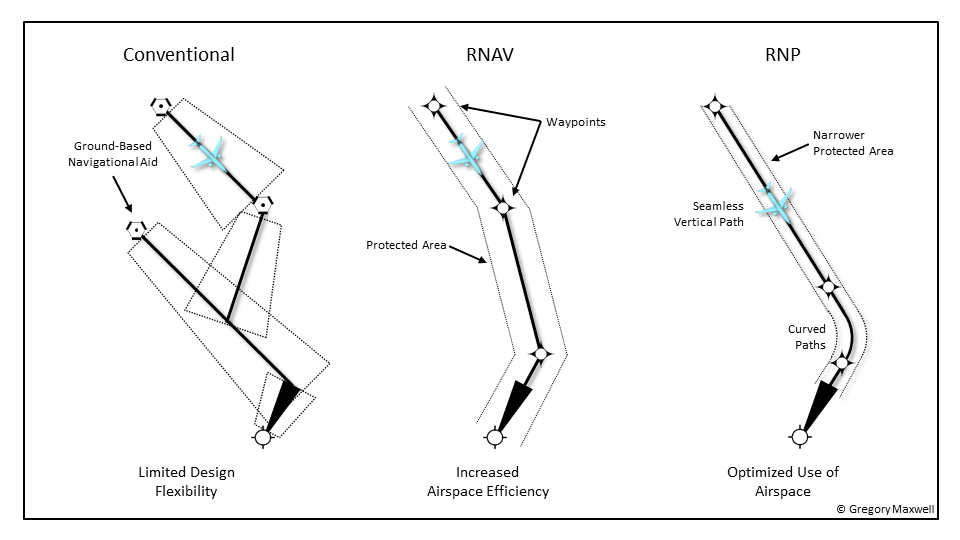
PBN specifies that RNP and RNAV systems performance requirements be defined in terms of accuracy, integrity, availability, continuity, and functionality required for the proposed operations in the context of a particular airspace when supported by the appropriate navigation infrastructure. One of the primary goals of PBN is to develop a global standard for RNAV and RNP specifications and eliminate the proliferation of different specifications from country to country.
To use PBN operator's aircraft fleets must meet various avionics equipment standards based on the type of procedure to be flown. Not all aircraft are capable of flying every PBN procedure, and due to the aircraft's age, the cost of equipping them to meet these standards may not be cost-effective.
This concept of air traffic management offers many operational benefits including:
Environmental
- Reduction in emissions by saving fuel, 6.9 lb. of CO2 emissions are eliminated for every 2.2 lb. of fuel savings achieved through shorter and vertically optimized PBN flight paths. In addition, PBN provides a mechanism for optimized profile descents that allow aircraft to descend from cruise altitude to the airport at minimum thrust settings.
- Reduces noise pollution. Consistent precise paths can be routed to avoid noise-sensitive areas. Noise levels can often be reduced through the use of optimized profile descents, which allow lower, quieter thrust levels.
Safety
- Reduces the risk of Controlled Flight Into Terrain (CFIT) accidents by providing a very precise lateral and vertical flight path.
- Provides consistent, predictable, and stabilized approaches. Aircraft arrive at the runway aligned with the centerline, in the same configuration, and at the same speed every time.
- Reduces diversions caused by adverse weather conditions, enabling aircraft to reliably access airports with lower visibility restrictions.
Operations
- Reduces fuel waste through shorter flight tracks, optimized profile descents, and few diversions. Enables more direct and closely spaced parallel tracks en route for increased fuel efficiency and reduced flight time variance. More efficient departure operations enable fuel savings from decreased taxi/ground waiting times.
- Provides a degree of precision approach capability without the investment required for expensive ground-based infrastructure.
- Reduces dependence on radar vectoring, altitude, and speed assignments allowing a reduction in required ATC radio transmissions.
- Creates new market opportunities by providing safe access to terrain and weather challenged destinations. PBN also provides a path for airline growth as emissions caps are implemented around the world.
- Improves customer satisfaction/customer loyalty by allowing airlines to more consistently access airports serviced at higher on-time rates.
Capacity
- Increases traffic capacity through more efficient routes and smoother flows. Reduces airspace conflicts between adjacent airports and prohibited or special use airspace.